
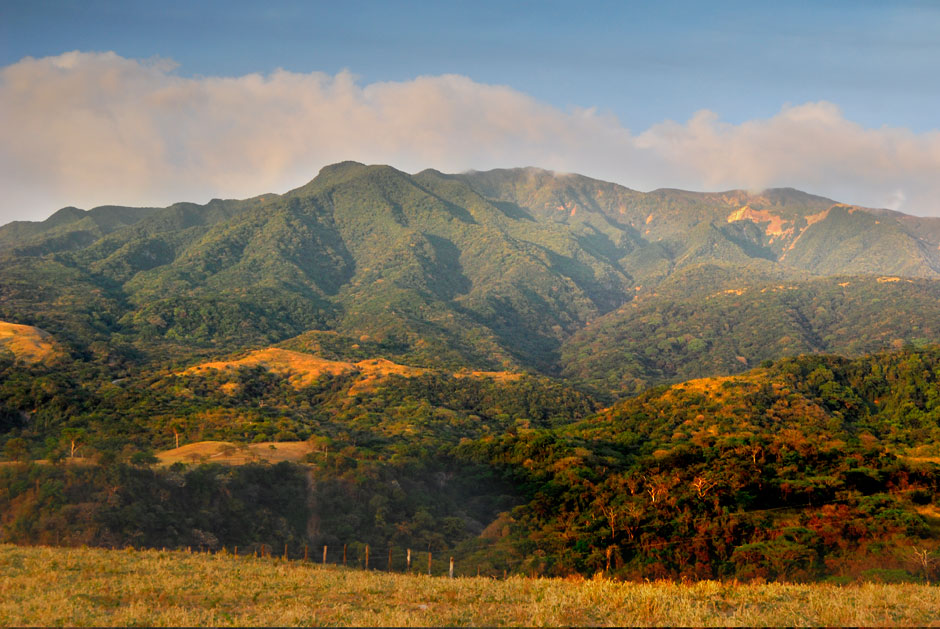
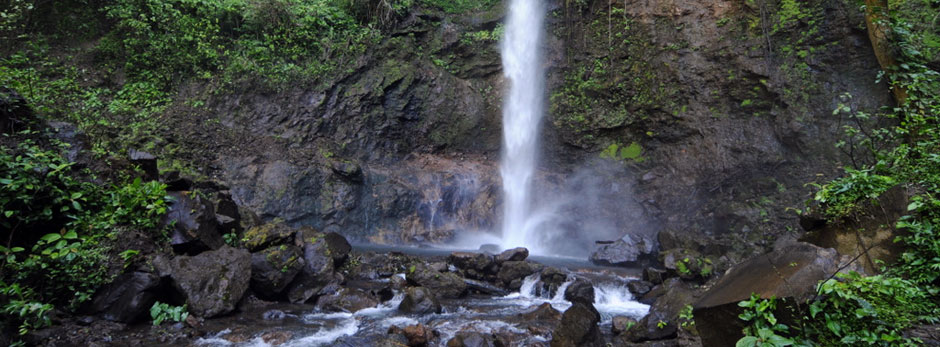
Guanacaste is famous for its beaches, but some of the best days of your trip may be inland. Within two hours of Liberia airport (LIR) you can walk past boiling mud pots on an active volcano, soak in hot springs, see a river that runs sky blue, and watch crocodiles and storks from a riverboat. The region's dry forest is protected as a UNESCO World Heritage Site. Here's how the three volcanoes compare, and the other parks worth a day.
Rincón de la Vieja vs Miravalles vs Río Celeste
| Compare | Rincón de la Vieja | Miravalles | Tenorio / Río Celeste |
|---|---|---|---|
| Drive from LIR | 35–40 km, 45 min – 1 h 15 (Las Pailas) | About 65 km, about 1 h | 90–105 km, 1 h 30 – 2 h |
| What you do | Mud pots and fumaroles on the Las Pailas loop, waterfall hikes, hot springs and mud baths, zipline and horseback riding at the ranches | Hot springs and mud baths at private reserves, a walk among steaming vents at Las Hornillas, waterfalls | A rainforest trail to the blue waterfall, a blue lagoon, bubbling hot springs and the Teñideros, where the river turns blue |
| Best for | A first volcano day; families; a night in the foothills | Quieter hot springs with fewer crowds | Photographers and hikers, or a stop on the way to La Fortuna |
| Hours and closures | Las Pailas Tue–Sun 8:00–15:00, closed Mondays; Santa María sector Thu–Mon. Crater trail closed. | Declared a national park in 2019 but still being opened; visits are at private reserves with their own hours | Daily 8:00–16:00, last entry 13:45. No swimming. Waterfall viewing stairs closed since mid-2025. |
| Tickets | Online only (SINAC); foreign adults $16.95, children 2–12 $5.65 | Paid at each reserve or hot spring | Online only, with a time slot; foreign adults $12, children $5, plus tax |
| Volcano status | Alert level 3 (caution), frequent eruptions since July 2026 | Dormant; powers a geothermal plant | No alert |
Fees are as published in September 2026 and change often. Buy park tickets on the SINAC reservation site; Rincón de la Vieja and Tenorio don't sell tickets at the gate. For drive times from the beaches, see Guanacaste drive times.
Rincón de la Vieja volcano: 2026 status
Rincón de la Vieja has been more active in 2026 than in years. After a run of steam-driven (phreatic) eruptions, OVSICORI, Costa Rica's volcano observatory, raised it to level 3, "caution," on July 24, 2026. More than 100 eruptions were recorded in July and August, some sending lahars (fast flows of mud and rock) down the rivers on the volcano's northern flank: the Pénjamo, Azul and Pizote rivers and the Azufrada stream. On September 2 the national emergency commission (CNE) placed five communities on green alert: Dos Ríos and Aguas Claras (Upala), and Mayorga, Cañas Dulces and Curubandé (Liberia). On September 18 the volcano had one of its strongest eruptions of the year.
The green alert is not an evacuation order and not a park closure. The active-crater trail is closed; in September 2026 the conservation area still listed the Las Pailas loop and the waterfall trails as open. OVSICORI's advice is to stay off the summit and away from riverbeds near the volcano.
Check before you go. This is the situation as of September 22, 2026, and it can change within a day. The week you travel, check the Las Pailas page of the Guanacaste Conservation Area and SINAC for closures, and ask your lodge or hot spring if they're operating normally.
Rincón de la Vieja National Park
The park covers about 141 km² of the Guanacaste mountain range, including the Rincón de la Vieja and Santa María volcanoes, and was created in 1973. The ground is alive with geothermal activity: fumaroles, hot springs and bubbling mud pots. It's 35 to 40 km from Liberia airport, and the last stretch to the Las Pailas entrance crosses Hacienda Guachipelín's private road, which has a small toll of about 800 colones.
Las Pailas sector
- Las Pailas loop (3 km, about 2 hours with stops). The easiest and most popular trail, past boiling mud pots ("pailas") and steam vents, with a wheelchair-accessible section. Some features reach 78 to 106 °C, so stay on the trail.
- Waterfall trails. La Cangreja is 5 km each way (4 to 5 hours round trip) and La Escondida 4.3 km each way. Access is from 8:00 to 12:00 in the dry season, so start early. Swimming at the waterfalls is not allowed.
- Active crater. The summit trail is temporarily closed because of the volcano's activity.
Santa María sector
The quieter Santa María entrance opens Thursday to Monday, 8:00 a.m. to 3:30 p.m. It's handy on a Monday, when Las Pailas is closed, but the road is rougher: a 4x4 is recommended.
Insider tip: I tell travelers to do Las Pailas in the morning and save the afternoon for a hot spring and mud bath nearby. You're right there, and a warm soak is exactly what you want after the trail. Just don't plan it for a Monday.
Staying in the foothills? See our Liberia airport to Rincón de la Vieja page, and where to stay in Guanacaste for how a night near the volcano fits with a beach stay.
Miravalles Volcano
Miravalles is the quiet one of the three. It's considered dormant, but the heat underground still powers a large geothermal plant and feeds a cluster of hot springs around Guayabo and Fortuna de Bagaces, about an hour from Liberia. In 2019 it was declared the Miravalles Jorge Manuel Dengo National Park (4,300 hectares), which is still being opened to the public, so for now you visit through private reserves.
The highlight is Las Hornillas, where you walk through a steaming volcanic area of mud pots, fumaroles and sulfur crystals, then soak in hot pools and try a mud bath. The summit is reached over private farmland on a steep, muddy trail; go with a local guide if you want to climb it. Compare the Miravalles springs in our hot springs and mud baths guide.
Tenorio Volcano National Park and Río Celeste
Río Celeste is the sky-blue river in Tenorio Volcano National Park, 1 hour 30 to 2 hours from Liberia airport via Cañas and Bijagua. The color comes from tiny mineral (aluminosilicate) particles in the water that scatter sunlight. The main trail is 6 to 7 km round trip and takes about 3 hours, past the waterfall viewpoint, the Laguna Azul, the Borbollones (hot springs bubbling up through the river) and the Teñideros, where two clear streams meet and turn blue.
- Hours: daily 8:00 a.m. to 4:00 p.m., last entry 1:45 p.m. Buy a time-slot ticket online beforehand; rangers are strict about the slot.
- No swimming anywhere in the park.
- The waterfall: the stairs down to the viewing platform have been closed since a landslide in mid-2025. You can go partway down and still see the falls, just not up close.
Río Celeste fits neatly into the drive from Guanacaste to Arenal: the route via Bijagua passes close by. See Liberia airport to La Fortuna.
Guanacaste Conservation Area, a UNESCO World Heritage Site
The Área de Conservación Guanacaste (ACG) was inscribed as a UNESCO World Heritage Site in 1999 and extended in 2004. It protects about 1,470 km² of land and sea in Costa Rica's northwest, including Santa Rosa National Park, Guanacaste National Park, Rincón de la Vieja National Park and the Junquillal Bay Wildlife Refuge. It contains an unbroken stretch of tropical dry forest, one of the most threatened forest types in the tropics, and habitat for species such as the Central American tapir and the great green macaw. When you visit Rincón de la Vieja or Santa Rosa, you're in it.
Santa Rosa National Park
About 36 km north of Liberia on the Inter-American Highway (Route 1), Santa Rosa was created in 1966 to protect a piece of history as much as nature. On March 20, 1856, Costa Rican forces attacked the American filibuster William Walker's men at La Casona, the old hacienda house; the battle lasted 14 minutes and ended Walker's push into Costa Rica. La Casona is now a museum. Around it are dry-forest trails, including the Indio Desnudo trail, with around 250 bird species and white-faced monkeys and coatis.
- Hours: Wednesday to Monday, 8:00 a.m. to 3:30 p.m., closed Tuesdays. Reserve at least 24 hours ahead. Foreign adults $16.95, children 2–12 $5.65.
- Playa Naranjo is 11 km from the park headquarters on a rough track that needs a high-clearance 4x4. As of September 2026 the park says it is not accessible, and the track is impassable in the rainy season anyway. From the Mirador Valle Naranjo trail you can see Witch's Rock, the famous surf break.
- Nancite, next to Naranjo, is one of the Pacific's great olive ridley nesting beaches, with mass arrivals ("arribadas") mainly in the rainy season, peaking in September and October.
To the west, the Santa Elena Peninsula is some of the oldest land in Costa Rica: its peridotite rocks formed in the Early Cretaceous, more than 100 million years ago, as ocean floor. Just north of it, the Isla Bolaños Wildlife Refuge protects one of the few places in the country where brown pelicans, magnificent frigatebirds and American oystercatchers nest.
Palo Verde National Park
If you like birds, go to Palo Verde. The park protects 18,400 hectares of marshes, lagoons and seasonally flooded grassland along the Tempisque River, and it's a Ramsar wetland of international importance. In the dry season, when water elsewhere disappears, birds gather here by the thousands: jabirus, roseate spoonbills, wood storks, herons and scarlet macaws. Isla de Pájaros is Costa Rica's main nesting site for black-crowned night-herons.
Most people see Palo Verde from a boat. Tours on the Tempisque River last about 1.5 hours in a covered boat, with crocodiles, iguanas and howler and white-faced monkeys along the banks and hardly any walking, which makes it a good half day for families and older travelers. The park is about 60 km (roughly an hour) from Liberia airport. December to April is best, when migratory birds join the residents.
Barra Honda National Park
Barra Honda, near Nicoya and about 1.5 hours from Liberia airport, is Costa Rica's cave park. On a guided tour you hike about 1.5 hours uphill through dry forest, then climb down ladders 60 meters into Terciopelo Cave, known for formations such as the "fried eggs" stalagmites. Tours leave at 8:30 and 10:30 a.m., a park guide is required, walk-ups are turned away, and the minimum age is 10. Wear closed-toe shoes.
Arenal and Monteverde from Liberia
Southeast of Guanacaste, the rainforests of Arenal and the cloud forest of Monteverde are a natural second half of a trip that starts at Liberia. La Fortuna is 3 to 3.5 hours away (2.5 to 3 hours via Bijagua and Río Celeste) and Monteverde 2.5 to 3 hours. See Liberia airport to La Fortuna, Liberia airport to Monteverde and our Guanacaste itineraries. For guided park days, see tours near Liberia, and for the dry and green seasons, the best time to visit Guanacaste.
Frequently asked questions
Which volcano near Liberia is best to visit?
For a first visit, Rincón de la Vieja. It's the closest (45 minutes to 1 hour 15 from Liberia airport), it has the most to do in one day (bubbling mud pots, waterfall hikes, hot springs and mud baths), and there are lodges right by the park. Choose Río Celeste in Tenorio Volcano National Park if you want the famous sky-blue river and rainforest, especially on the way to La Fortuna. Choose Miravalles for quieter hot springs and mud baths. Check the 2026 volcano status before you go.
Is Rincón de la Vieja safe to visit?
The park's visitor trails have stayed open, but the volcano is very active. OVSICORI, the national volcano observatory, has kept it at level 3 ("caution") since July 24, 2026, and the national emergency commission (CNE) put five nearby communities on green alert on September 2. The crater trail is closed, and authorities ask people to stay out of the riverbeds that drain the volcano. Check SINAC and the latest news the week you travel.
Is Rincón de la Vieja National Park open on Mondays?
The Las Pailas sector, where most visitors go, is closed on Mondays. It's open Tuesday to Sunday, 8:00 a.m. to 3:00 p.m. The quieter Santa María sector opens Thursday to Monday, 8:00 a.m. to 3:30 p.m. Tickets are sold online only.
What is there to do at Rincón de la Vieja?
Walk the 3 km Las Pailas loop past boiling mud pots and steam vents, hike to La Cangreja or La Escondida waterfall (start in the morning), then spend the afternoon in a hot spring and a volcanic mud bath. The ranches around the park add ziplining and horseback riding. Our hot springs and mud baths guide compares the options.
How do I get from Liberia to Rincón de la Vieja?
It's 35 to 40 km from Liberia airport, paved to Curubandé and then an unpaved stretch, so plan on 45 minutes to 1 hour 15. The last part crosses Hacienda Guachipelín's private road, which has a small toll. A car works in the dry season; see our Liberia airport to Rincón de la Vieja page if you'd rather be driven.
Is Miravalles volcano safe to hike?
Miravalles is considered dormant, and the national park declared in 2019 is still being opened to the public, so there's no park trail to the summit. The routes up cross private farms and are steep, muddy and slippery in the cloud forest. If you want to climb it, go with a local guide. Most visitors enjoy Miravalles from its hot springs and mud baths instead.
Can you swim in Río Celeste?
Not inside Tenorio Volcano National Park: swimming is prohibited. Since mid-2025 the stairs down to the waterfall viewing platform have also been closed, so you see the falls from partway down. You can still walk the trail to the blue lagoon, the bubbling hot springs and the Teñideros, where two clear rivers meet and turn blue.
How do I get from Liberia to Arenal Volcano?
It's 140 to 180 km and 3 to 3 hours 30 around Lake Arenal, or about 2 hours 30 to 3 hours via Bijagua and Upala, which also takes you past Río Celeste. Drive it in daylight: the lake road is narrow, curvy and unlit. See Liberia airport to La Fortuna.